Welded vs Woven Gabion Baskets
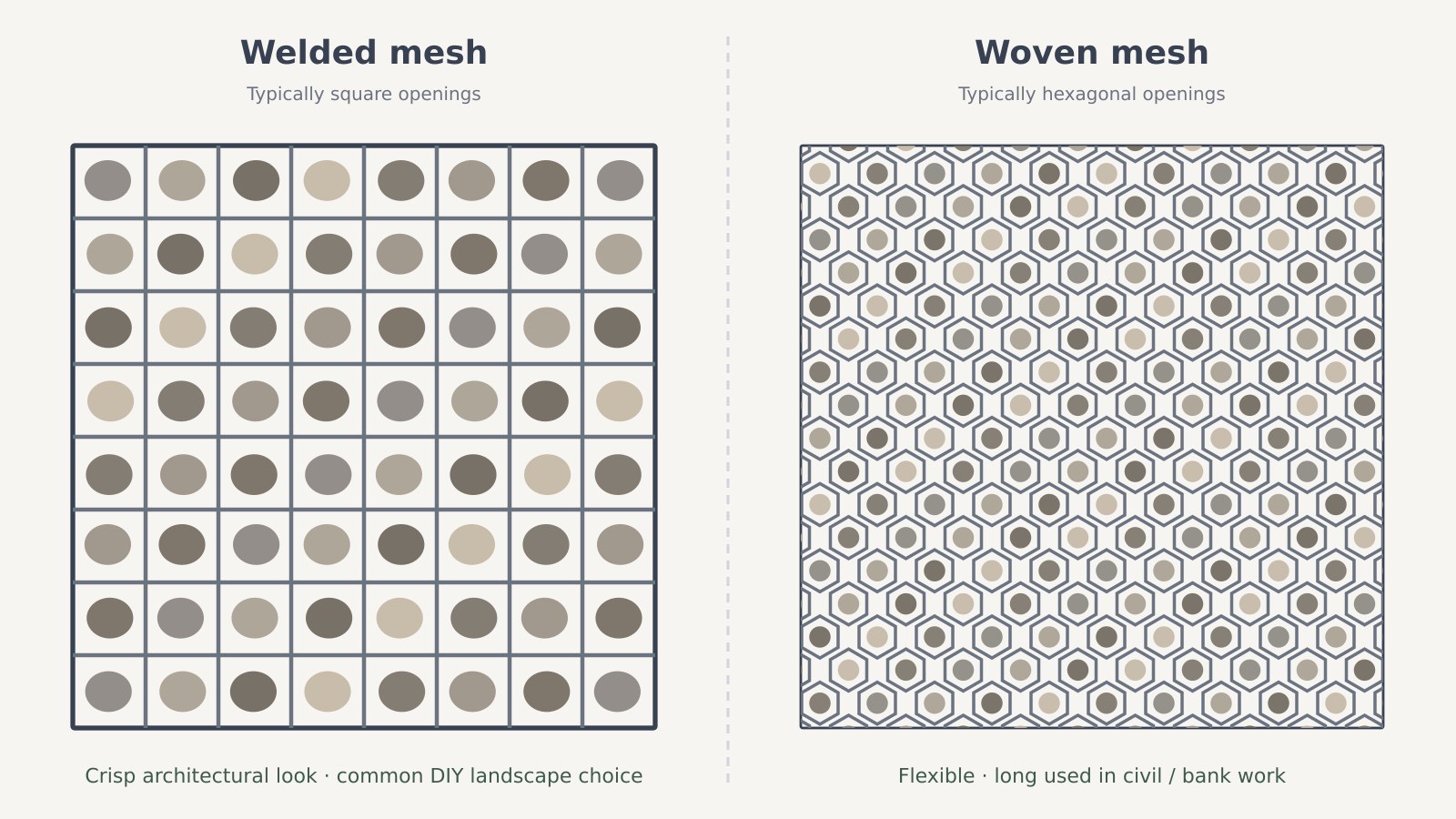
Choosing welded or woven mesh is the first major product decision for most gabion projects. GabionBaskets.com breaks the choice into look, flexibility, assembly feel, and typical use — without pretending one type wins every job.
Both families can be galvanized and optionally polymer-coated. For coatings depth, see Mesh and coatings. For how baskets are sized, see the sizes and spec guide.
Quick definitions
Welded gabion mesh is wire fabric with a resistance weld at each intersection, usually in a square or rectangular pattern. In North American practice, welded gabions are commonly discussed alongside ASTM A974-style product literature.
Woven (double-twisted) gabion mesh is made by twisting pairs of wires into a hexagonal mesh that resists unraveling if a wire breaks. It is commonly discussed alongside ASTM A975-style product literature (often mesh type 8×10 with a nominal opening near 3.25 in / 83 mm).
Exact openings, wire diameters, and coatings vary by manufacturer — treat numbers below as typical published ranges, not a purchase guarantee.
Side-by-side comparison
| Topic | Welded mesh | Woven (double-twisted) mesh |
|---|---|---|
| Look | Clean, architectural grid; popular for visible garden and patio walls | Classic hexagonal “civil” look; softer visual texture |
| Shape when filled | Often holds flatter faces with less bulge when properly braced | More flexible; can conform slightly to uneven support |
| Common mesh opening (typical) | Often about 3 in × 3 in (75 mm × 75 mm) for baskets; other spacings exist | Often about 3.25 in (83 mm) nominal for common 8×10 mesh (± tolerance per datasheet) |
| Wire diameter (typical ranges) | Often roughly 0.106–0.120 in (2.7–3.05 mm) for basket mesh (coating style dependent) | Mesh wire often near 0.120 in (3.05 mm) galvanized in many Style 1 charts; PVC-coated styles use different finished diameters |
| DIY / landscape feel | Frequently preferred when appearance and crisp lines matter | Excellent pedigree for banks, channels, and flexible structures; also used in walls |
| Assembly vibe | Panels often raised and joined with spirals, lacing, or rings | Baskets may ship folded; laced or fastened per instructions |
| Standards you’ll see cited | ASTM A974 (welded wire fabric gabions/mattresses) | ASTM A975 (double-twisted wire mesh gabions) |
| When it may struggle | Less “forgiving” if the structure must drape over irregular settlement without design care | Faces can look less “furniture-like” if you want a modern grid aesthetic |
Uncertainty flag: Custom architectural mesh (finer openings, stainless, etc.) exists outside these “standard basket” ranges — always read the seller’s spec sheet.
Which should a homeowner pick?
Lean welded if you want…
- A modern, squared-off stone cage look
- Decorative walls, seating, columns, or planters in a finished yard
- Easier visual matching to outdoor furniture and hardscape lines
Lean woven if you want…
- A flexible structure for bank or drainage-related work (often with professional guidance)
- Continuity with civil/erosion-control practice and double-twist mesh tradition
- A classic hexagonal appearance you actually prefer
Either can work for…
Low garden walls and many modest landscape features — provided mesh opening, wire coating, fill size, foundation, and bracing match the job. Mesh type alone does not make a tall wall “safe.”
Mesh opening ↔ stone fill (don’t skip this)
Whatever mesh you choose, fill stone must be larger than the openings so rock cannot escape. For many standard baskets, industry guidance commonly points to a predominant stone size around 4–8 in (100–200 mm). Finer decorative mesh needs carefully matched fill (or an inner liner — only if the manufacturer allows it for your use case).
Coatings matter as much as weld vs weave
A lightly protected wire in a wet, salty, or abrasive setting can fail early regardless of mesh pattern. Common options you’ll see:
- Zinc galvanizing (various classes)
- Zinc-aluminum alloy coatings (sometimes marketed under trade names)
- PVC or similar polymer over metallic coating for extra corrosion and abrasion resistance
Details and caveats: Gabion mesh and coatings.
Installation differences (high level)
Both types need:
- Level, suitable foundation preparation
- Correct fastening of panels/edges
- Internal bracing / crossties on taller exposed faces
- Careful filling (minimize big drop heights; place face stone thoughtfully for appearance)
- Secure lid closure
Educational overview: How to install gabion baskets. Mistakes to avoid: Common gabion mistakes.
How this differs from a seller catalog
Retail/supplier sites may stock welded mesh systems and woven mesh systems with quote buttons and house size codes. That’s a buying experience. This page on GabionBaskets.com is a decision guide: we explain tradeoffs so you can read any catalog intelligently — we do not sell baskets or invent SKUs here.
Related guides
- What are gabion baskets?
- Sizes and spec guide
- Retaining walls · Landscape & garden
- DIY vs contractor · FAQ
Educational disclaimer: Content on GabionBaskets.com is for general education only. It is not a site-specific design, engineering stamp, or construction contract. Tall walls, walls supporting structures or traffic, channel work, and other critical applications need a qualified designer or engineer. Always follow local building codes, permits, and the manufacturer’s assembly instructions for the baskets and coatings you buy.