
Gabion Mattresses Explained
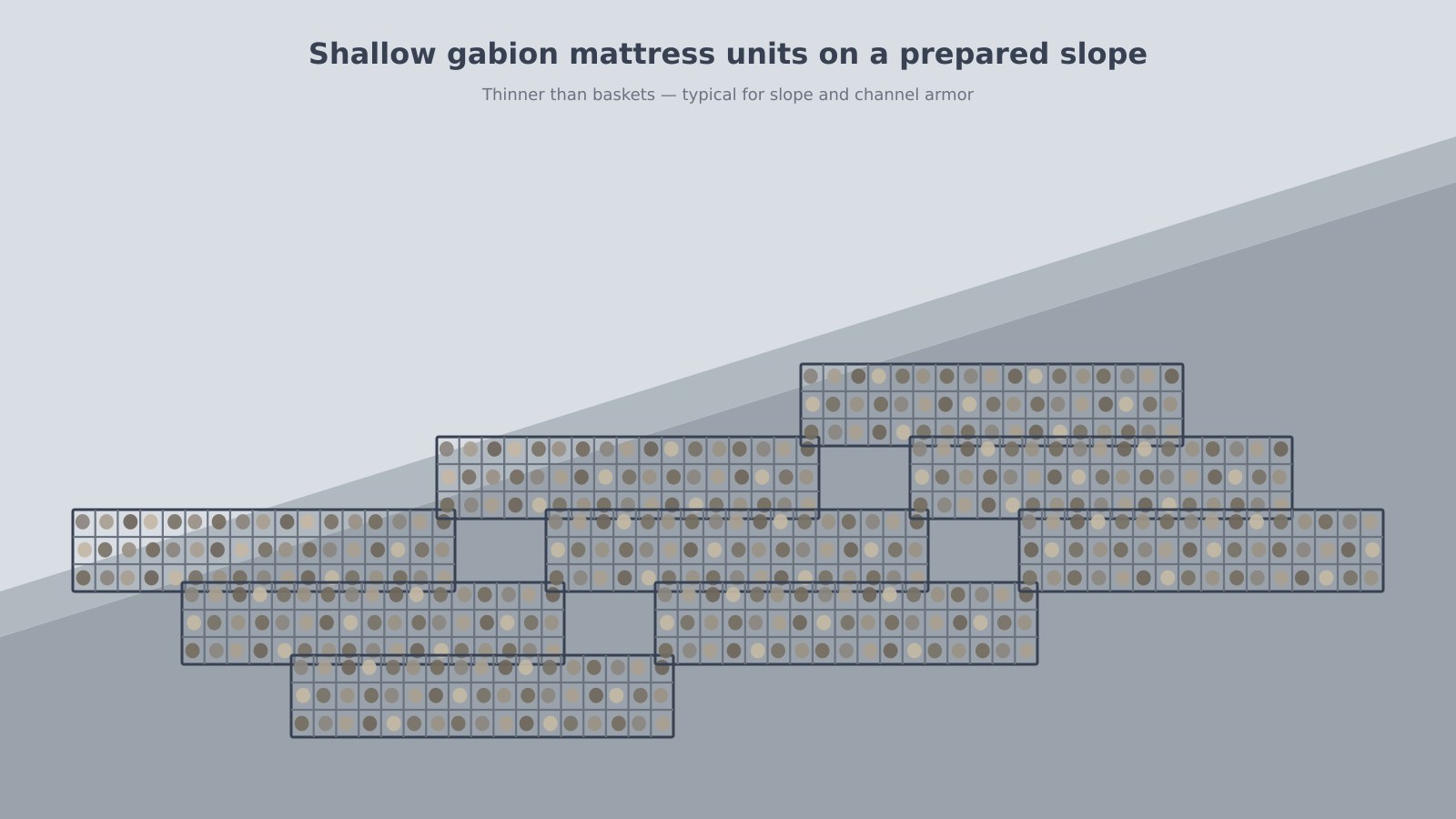
A gabion mattress (often called a reno mattress in industry conversation) is a shallow, wide wire-mesh unit filled with stone. Think of it as a flexible rock blanket rather than a deep wall block. Mattresses are commonly used to armor slopes, channel beds and banks, and other surfaces where you need coverage more than freestanding height.
GabionBaskets.com explains mattresses so you can read supplier charts intelligently. We do not sell mattresses or invent project thicknesses.
Mattress vs basket (quick contrast)
| Topic | Gabion basket | Gabion mattress |
|---|---|---|
| Shape mindset | Deeper box / modular wall unit | Large footprint, small thickness |
| Typical jobs | Walls, terraces, stacked structures, toe berms | Slope blankets, channel linings, bed/bank armor |
| Homeowner visibility | Common in garden/retaining DIY talk | More often a civil / drainage product |
| Fill size (typical guidance bands) | Often about 4–8 in (100–200 mm) predominant | Often about 3–6 in (75–150 mm) in parallel public-guidance-style tables |
| Mesh | Common basket openings (e.g. ~3 in / 75 mm welded; ~3.25 in / 83 mm woven 8×10) | Often smaller or different aspect openings in manufacturer charts (e.g. about 1.5 in × 3 in / 38 mm × 75 mm welded in some A974-oriented tables) |
Basket definition refresher: What are gabion baskets?. Water-adjacent context: Erosion & riverbanks.
How a mattress works
- Mesh panels form a shallow compartment (often subdivided by diaphragms into cells).
- Workers place the empty unit on a prepared surface (frequently over geotextile filter as specified).
- Stone is packed to create a continuous armor layer.
- Lids are closed and units are laced or fastened to neighbors so the blanket acts as one system.
The goal is surface protection and flexibility, not a tall gravity wall face.
Typical dimensions (common chart language)
Manufacturer technical sheets and standards-oriented catalogs list many mattress footprints. Exact sizes vary by brand. Educational patterns you will often see:
- Thickness commonly on the order of about 6 in, 9 in, or 12 in (about 150 mm, 230 mm, or 300 mm) in many tables — sometimes other shallow depths
- Plan dimensions much larger than baskets — for example lengths and widths on the order of 9 ft × 6 ft (about 2.7 m × 1.8 m) and similar modular sheets in foot-based charts, or metric families in international woven catalogs
Treat every number as typical, then confirm the datasheet. Broader size literacy: Sizes and spec guide.
Uncertainty flag: DIY “garden cage” products marketed online are not automatically equivalent to civil mattress products used in channel specs.
Welded vs woven mattresses
Both families appear in the market:
- Woven (double-twisted) mattresses — often discussed with ASTM A975-style literature; valued for flexibility and traditional civil use
- Welded mattresses — discussed with ASTM A974-style literature; rectangular mesh openings; assembly may feel more “panel-like”
Coatings (zinc, zinc-aluminum, PVC/polymer over metallic) matter in wet and abrasive service: Mesh and coatings. Mesh choice overview: Welded vs woven.
Fill stone for mattresses
Public NRCS-style construction guidance and similar industry tables often pair mattresses with a predominant rock size around 3–6 in (75–150 mm) — still larger than the mesh openings so stone cannot escape. Durability, shape, and gradation requirements in formal specs can be stricter than backyard decorative fills.
→ Practical selection tips: Gabion fill stone
When mattresses show up on residential property
Homeowners may encounter mattresses when:
- A drainage contractor lines a ditch or swale
- A bank repair includes a stone blanket at the toe or face
- A site plan calls for flexible armor instead of poured concrete lining
DIY homeowners occasionally use shallow cages for decorative dry creek beds — that is not the same as designing live-channel armor. If water flows with real energy, hire qualified help (DIY vs contractor).
Installation notes (educational, not a method statement)
Formal projects typically address:
- Subgrade preparation and compaction as specified
- Geotextile filters to limit soil piping through voids
- Correct orientation, stretching/squaring of mesh, and fastening
- Controlled stone placement (avoid damaging coatings with excessive drop heights)
- Continuous lacing/connection so units cannot peel apart under flow
- Toe details and edge anchors so flow cannot get under the blanket
Manufacturer instructions and the project engineer’s drawings govern. High-level basket assembly habits still apply where relevant: How to install gabion baskets.
Cost and procurement
Mattress pricing follows the same drivers as baskets — mesh type, coating, size, freight, and especially stone + placement labor. Channel work also adds design, permits, and access equipment. See Cost factors. GabionBaskets.com does not publish a fake mattress SKU list.
Related pages
- Erosion control & riverbanks
- Retaining walls · Landscape & garden
- Sizes & specs · Common mistakes
- Hub: Homepage
Educational disclaimer: Content on GabionBaskets.com is for general education only. It is not a site-specific design, engineering stamp, or construction contract. Tall walls, walls supporting structures or traffic, channel work, and other critical applications need a qualified designer or engineer. Always follow local building codes, permits, and the manufacturer’s assembly instructions for the baskets and coatings you buy.