Gabion Mesh and Coatings
Mesh pattern and wire coating decide how a gabion looks, how it assembles, and how it ages outdoors. GabionBaskets.com explains the language you will see on datasheets — galvanizing, zinc-aluminum alloys, and polymer (often PVC) overcoats — without inventing proprietary life guarantees.
For welded vs woven structure, start with Welded vs woven. For openings and diameters in context of basket size, see Sizes & specs.
Two mesh families (quick refresh)
| Family | Typical look | Standards you will see cited |
|---|---|---|
| Welded | Square/rectangular grid, resistance welds at intersections | Often discussed with ASTM A974-style literature |
| Woven (double-twisted) | Hexagonal mesh; resists unraveling if a wire breaks | Often discussed with ASTM A975-style literature |
Coatings apply to both families. Mesh type and coating are separate decisions.
Mesh opening (buyer literacy)
| Mesh family | Opening commonly quoted | Practical note |
|---|---|---|
| Welded baskets | Often about 3 in × 3 in (75 mm × 75 mm) | Other architectural spacings exist |
| Woven baskets | Often 8×10 mesh with nominal D ≈ 3.25 in (83 mm) | Opening tolerance is often about ±10% of nominal in ASTM A975-oriented texts |
| Mattresses | Often smaller / different aspect (e.g. about 1.5 in × 3 in / 38 mm × 75 mm in some welded charts) | See Mattresses |
Rule that never changes: fill stone must stay behind the openings. Typical basket fill guidance is around 4–8 in (100–200 mm) — Fill stone.
Wire diameter language (typical chart ranges)
Datasheets list metallic core diameter, and separately a finished diameter after polymer coating. Marketing “gauge” numbers are less reliable than printed inches/mm.
| Role | Order-of-magnitude metallic sizes commonly charted | Notes |
|---|---|---|
| Welded basket mesh | About 0.106 in (2.7 mm) or 0.120 in (3.05 mm) | Rows differ for metallic-only vs PVC styles in A974-oriented tables |
| Woven basket mesh (e.g. 8×10) | Often near 0.120 in (3.05 mm) galvanized mesh wire in Style 1 charts; PVC styles may start from a smaller metallic core (e.g. about 0.106 in / 2.7 mm) with a larger finished OD | Selvedge (edge) wire is often heavier than mesh wire |
| Lacing wire | Often near 0.087 in (2.2 mm) class in charts | Used to sew edges and lids |
| Spiral binders (welded) | Often similar order to mesh wire | Check the kit spec |
Uncertainty flag: Custom architectural, stainless, or “garden cage” products online can sit far outside civil chart rows. Trust the datasheet for the SKU you buy.
Coating types in plain language
1. Zinc galvanizing (metallic coating alone)
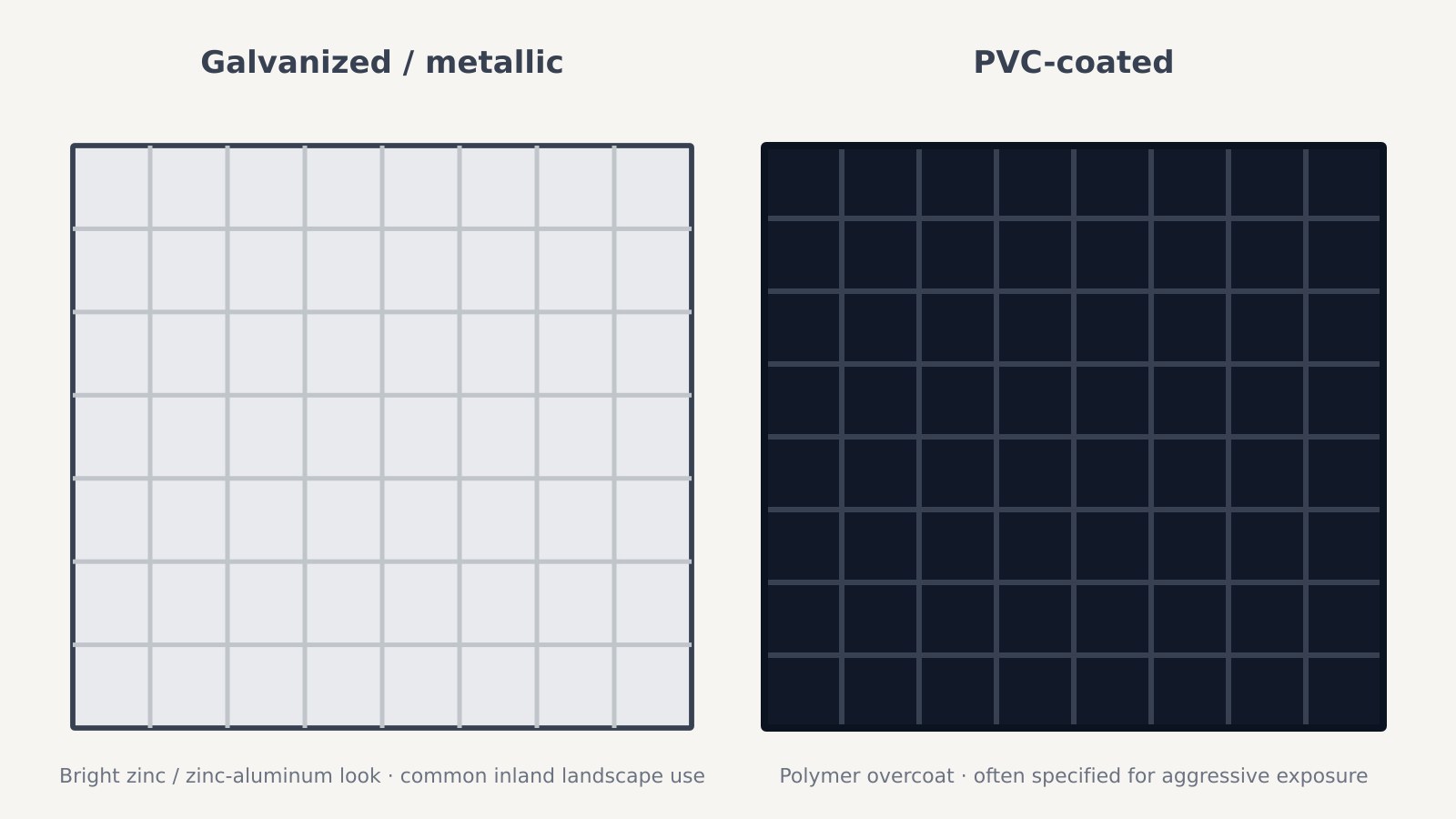
Wire is coated with zinc before (or as part of) mesh manufacture. Heavier zinc classes last longer in mild environments than light commercial coatings — manufacturers and ASTM-oriented styles distinguish coating classes rather than a single “galvanized” meaning.
Typical homeowner takeaway: Fine for many inland landscape features with moderate exposure when the product’s coating class matches the site. Not automatically enough for salt spray, industrial pollution, or constantly wet acidic soils.
2. Zinc-aluminum alloy coatings (often called Galfan-type)
Some products use a zinc-aluminum metallic coating (commonly discussed as Zn-5Al or similar alloy families; trade names vary). Sellers often position these as more corrosion-resistant than plain zinc in comparable thickness classes.
Typical homeowner takeaway: Ask for the coating standard/class on the datasheet, not just a marketing nickname. Alloy coatings are still metallic coatings — aggressive sites may still call for a polymer overcoat.
3. Polymer / PVC over metallic coating
A polymer layer (frequently PVC in civil gabion literature) is applied over the metallic coat. ASTM A974 / A975 texts describe metallic-coated wire with PVC coating as distinct styles. Manufacturer charts commonly cite a nominal PVC thickness on the order of about 0.02 in (0.50 mm) (some products list a band up to about 0.04 in / 1.0 mm — confirm the sheet).
Typical homeowner takeaway: Often specified where wire faces salt, polluted water, acidic soils, abrasion, or other aggressive exposure. Polymer raises the finished outer diameter and usually the price (Cost factors).
4. Other finishes
Stainless or specialty architectural meshes exist for design projects. They are not the default civil gabion SKU set — verify weldability, opening, and cost carefully.
When tougher coatings usually matter
Lean toward metallic + polymer (or the most durable metallic class your engineer specifies) when any of these apply:
- Coastal / salt-air sites or de-icing salt splash
- Constantly wet, acidic, or contaminated soils and water
- High-abrasion contact (debris-laden flow on mattresses/baskets)
- Long design life expectations in harsh exposure
- Critical civil or bank work (Erosion & riverbanks)
Many quiet inland garden walls use metallic-coated welded mesh successfully — site chemistry and water matter more than aesthetics alone.
Uncertainty / honesty flag: Some marketing materials quote multi-decade “design lives” for coating classes. Those are context-dependent estimates, not a GabionBaskets.com guarantee. We do not invent year ratings here.
ASTM “style” language (what the numbers mean)
Without pasting copyrighted tables:
- ASTM A975 (woven) classifies double-twisted mesh by coating style (metallic-only styles vs metallic + PVC styles).
- ASTM A974 (welded) likewise distinguishes metallic-coated fabric and PVC-coated variants, including how spirals/lacing/stiffeners are coated.
When a quote says “Style 1” or “Style 3,” ask the seller which standard and which coating description that style maps to on their chart.
Coatings vs DIY handling
Polymer coatings can be cut or scraped by careless stone placement or improvised tools. Educational install habits that protect coatings:
- Use approved lid tools, not sharp crowbars on coated edges
- Hand-place face rock instead of dropping from height onto the mesh
- Repair guidance — if any — comes from the manufacturer; we do not invent patch recipes
→ How to install · Common mistakes
Decision mini-table
| Site / goal | Coating lean (educational) |
|---|---|
| Dry inland planter / low decorative wall | Quality metallic coating often considered; still read the class |
| Wet soils, irrigation splash, mild corrosion risk | Heavier metallic class or metallic + polymer |
| Coastal, saline, industrial, channel abrasion | Metallic + polymer commonly specified in civil practice |
| Visible modern landscape grid | Often welded + chosen coating; look and durability both matter |
Related guides
- Welded vs woven · Sizes & specs
- Erosion & riverbanks · Cost factors
- FAQ · Install overview
- Hub: GabionBaskets.com homepage
Questions about our guides? See Contact. About · Privacy.
Educational disclaimer: Content on GabionBaskets.com is for general education only. It is not a site-specific design, engineering stamp, or construction contract. Tall walls, walls supporting structures or traffic, channel work, and other critical applications need a qualified designer or engineer. Always follow local building codes, permits, and the manufacturer’s assembly instructions for the baskets and coatings you buy.