
Common Gabion Basket Mistakes
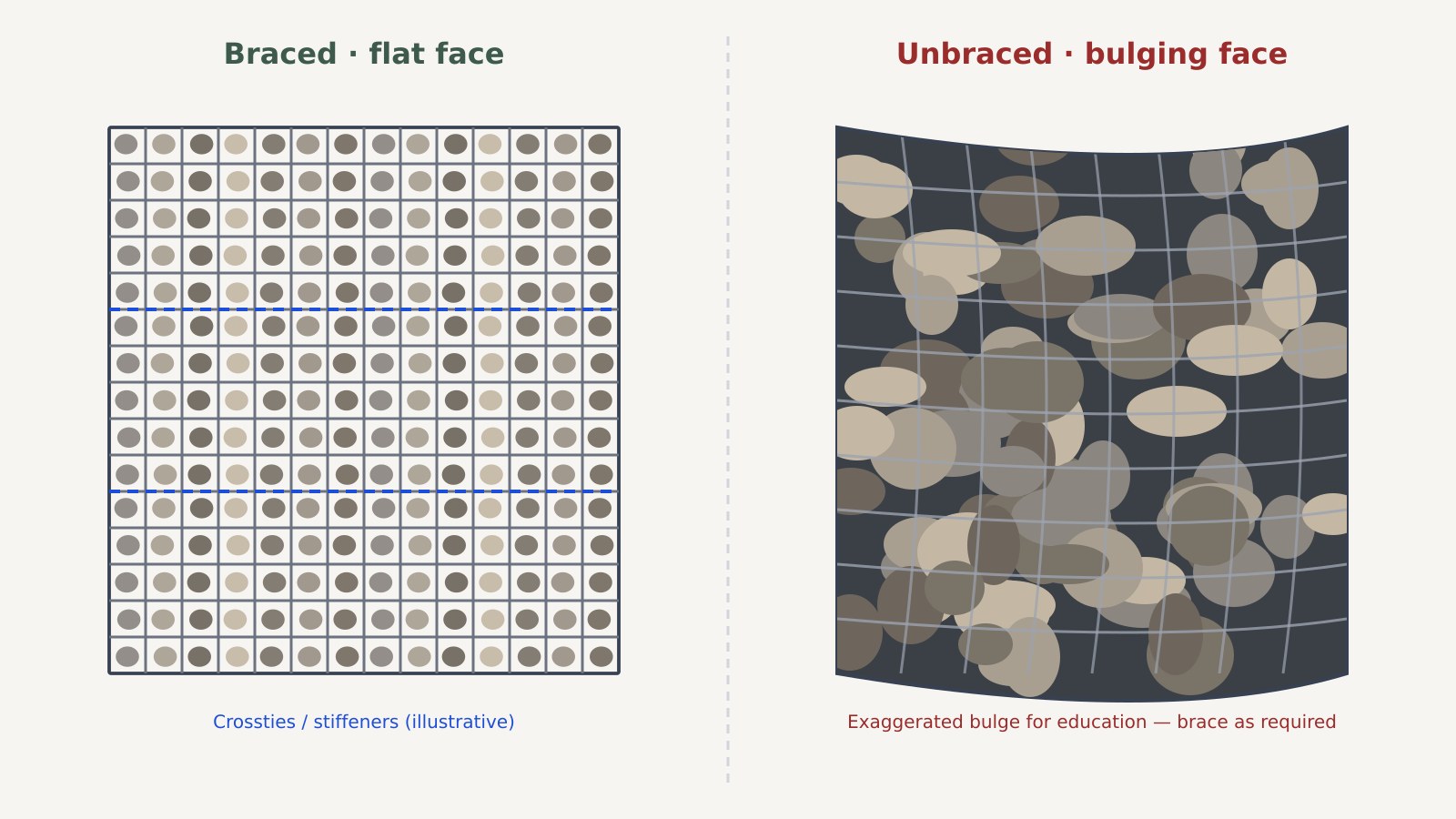
Most gabion disappointments are predictable: wrong stone, skipped bracing, rushed foundations, or treating a permeable cage like a complete drainage design. GabionBaskets.com collects the mistakes we see discussed most often in DIY builds and public construction guidance — so you can avoid learning them the expensive way.
Pair this page with How to install and DIY vs contractor.
Mistake 1 — Undersized (or dirty) fill stone
What goes wrong: Gravel or small cobbles work through the mesh; fines muddy the face and clog voids.
Prevention:
- Match stone to opening — for many standard baskets, industry tables point to about 4–8 in (100–200 mm) predominant size
- Inspect the stockpile before delivery
- Keep excessive clay/fines out of structural fill
Mistake 2 — Skipping internal bracing / stiffeners
What goes wrong: Tall unrestrained faces bulge outward as rock settles and lateral pressure grows. The wall looks pregnant; mesh stresses rise.
Prevention:
- Follow manufacturer stiffener/crosstie schedules
- Common public guidance calls for bracing in unrestrained cells taller than about 18 in (450 mm), placed as fills rise (often discussed around each 12 in / 300 mm of depth)
- Do not wait until the basket is full to “see if it needs braces”
Mistake 3 — Dump-and-run filling
What goes wrong: Huge voids, crooked alignment, scraped coatings, ugly faces, and cells that settle unevenly.
Prevention:
- Fill in lifts; keep adjoining cells within about 12 in (300 mm) of each other in fill depth (common construction-spec language)
- Machine-place, then hand-work
- Hand-dress exposed faces
Mistake 4 — Weak or unlevel foundation
What goes wrong: The first course leans; every course above amplifies the error. Soft spots settle differentially.
Prevention:
- Excavate to competent subgrade; remove organics
- Level carefully; use the granular base your design/manufacturer guidance calls for
- Check string-line alignment before committing stone tonnage
We do not invent embedment recipes — ask your product sheet or designer for critical walls (Retaining walls).
Mistake 5 — Open seams and lazy lid closures
What goes wrong: Edges open under load; lids lift; rock escapes; the structure loses integrity.
Prevention:
- Use the specified spirals, lacing, or rings continuously along seams
- Close lids with approved tools; lace/fasten to diaphragms and perimeter
- Connect adjacent baskets in a row before heavy filling
Mistake 6 — Wrong mesh or coating for the site
What goes wrong: Early rust in salt/acid exposure; architectural expectations unmet; mattress mesh used where basket stone sizes were assumed.
Prevention:
- Choose welded vs woven for look and use case — Welded vs woven
- Match coating to exposure — Mesh & coatings
- Do not mix mattress assumptions into wall builds — Mattresses
Mistake 7 — Assuming “permeable fill = drainage done”
What goes wrong: Clay backfill, trapped water, and surface runoff still overload the retained soil mass. Faces weep muddy water; pressure rises.
Prevention:
- Design a drainage path behind retaining runs (filter fabric, free-draining backfill, outlets as appropriate)
- Keep surface water from pounding the crest
- Treat drainage as a system, not a side effect of rock voids
Mistake 8 — Building too tall without design
What goes wrong: Sliding, overturning, bearing failure, or code violations. “It looked like the neighbor’s wall” is not engineering.
Prevention:
- Keep DIY walls low and lightly loaded
- Prefer terraces over one tall face
- Hire design help when surcharge, height, or poor soils appear — DIY vs contractor
- There is no universal DIY height that is safe everywhere
Mistake 9 — Ignoring water projects’ risk class
What goes wrong: Homeowner “bank armor” washes out, redirects erosion downstream, or violates permits.
Prevention:
- Treat channels, toe protection, and river work as professional territory — Erosion & riverbanks
- Mattresses and baskets in flowing water need proper sizing, anchoring, and often agency review
Mistake 10 — Shopping like a fake catalog
What goes wrong: Buying by letter codes or lowest empty-cage price without checking opening, wire class, coating, or stone availability. Freight and stone then blow the budget.
Prevention:
- Read dimensions, mesh, and coating on the datasheet — GabionBaskets.com does not run an A–F storefront
- Budget stone + freight early — Cost factors
- Confirm local rock exists in the size band you need before baskets arrive
Mistake 11 — Coating damage during placement
What goes wrong: PVC/polymer scrapes down to steel; corrosion starts early at cut edges.
Prevention:
- Avoid high drops and improvised pry bars on coated edges
- Hand-place face rock carefully
- Follow any manufacturer repair guidance — we do not invent patch chemicals here
Quick pre-flight checklist
| Check | Done? |
|---|---|
| Mesh opening ↔ stone size confirmed | ☐ |
| Coating matches exposure | ☐ |
| Foundation level and competent | ☐ |
| Fastener type and schedule understood | ☐ |
| Stiffeners/crossties on hand for tall cells | ☐ |
| Drainage plan for any retaining duty | ☐ |
| DIY vs pro decision honest for height/risk | ☐ |
| Permits / HOA checked | ☐ |
| Stone delivery and staging planned | ☐ |
Related guides
- Install overview · Fill stone
- Sizes & specs · Welded vs woven
- Retaining walls · FAQ
- Hub: GabionBaskets.com homepage
Questions about our guides? See Contact. About · Privacy.
Educational disclaimer: Content on GabionBaskets.com is for general education only. It is not a site-specific design, engineering stamp, or construction contract. Tall walls, walls supporting structures or traffic, channel work, and other critical applications need a qualified designer or engineer. Always follow local building codes, permits, and the manufacturer’s assembly instructions for the baskets and coatings you buy.