Gabions for Erosion Control and Riverbanks
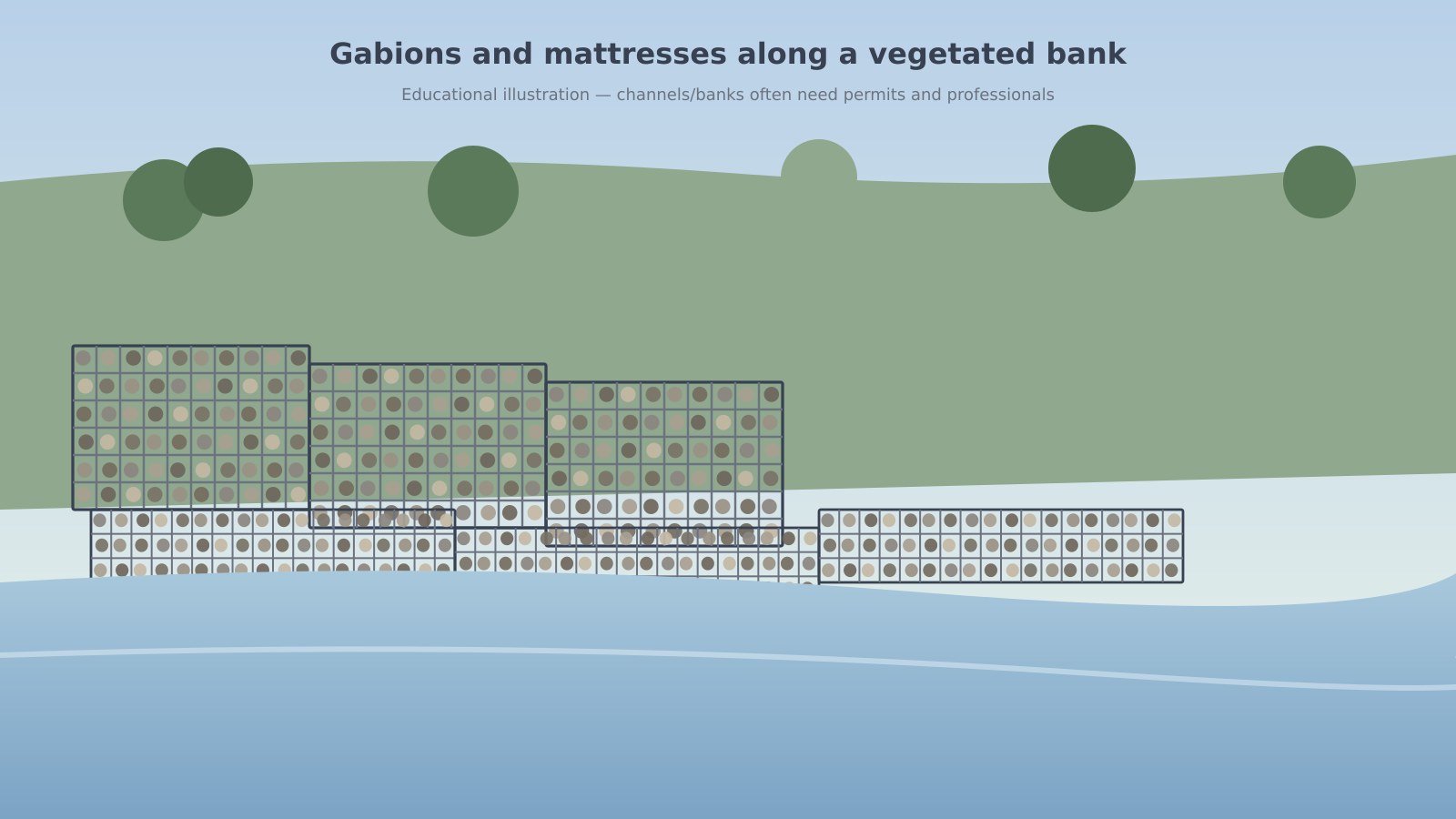
Gabions have a long civil-engineering pedigree in bank protection, channel lining, and toe armor. Stone-filled mesh can armor soil against flowing water while remaining permeable and somewhat flexible. That history is why you still see gabion baskets and gabion mattresses (sometimes called reno mattresses) along streams, ditches, and shorelines.
On GabionBaskets.com, this page explains the idea for curious property owners — and makes the risk boundary clear. Moving-water work is rarely a casual DIY weekend project.
What “erosion control with gabions” usually means
| Application | Typical unit | Plain-language goal |
|---|---|---|
| Bank / slope armor | Baskets and/or mattresses | Hold soil in place against scour and wave or flow attack |
| Channel lining | Often mattresses | Protect the bed and sides of a conveyance |
| Toe protection | Baskets or mattresses at the base of a slope | Stop undercutting that unravels the bank above |
| Outlet / energy dissipation areas | Engineered layouts | Protect soil where water exits culverts or channels |
Exact layouts, thicknesses, anchors, filters, and stone gradations belong in a site design — not a blog recipe.
Baskets vs mattresses in water-adjacent work
- Gabion baskets — deeper modules; used for walls, stacked bank structures, and toe berms.
- Gabion mattresses — large plan area, small thickness; commonly used to blanket slopes and channel surfaces.
Mattress overview: Gabion mattresses. Basket size literacy: Sizes & specs.
Why engineers like mesh + stone (in the right design)
Public construction practice (including NRCS-style and similar agency guidance families) often values gabions because:
- The fill is permeable, so water pressure can relieve differently than behind a solid wall
- Double-twisted woven mesh has a reputation for flexibility and for resisting unraveling if a wire breaks (ASTM A975-style products)
- Units can be laced into continuous blankets or walls that follow irregular ground better than some rigid armor
Welded mattress/basket products (ASTM A974-style literature) also appear in manufacturer charts for these roles — mesh family choice is a design decision, not a fashion tip.
Critical caveats for homeowners
1. Hydraulics are not DIY guesswork
Flow depth, velocity, debris, ice, tidal action, and flood frequency change what armor survives. Guessing mattress thickness or stone size from a photo is how projects fail in the first big storm.
2. Permits are common
Work in or near streams, wetlands, floodplains, and shorelines often needs local, state, and sometimes federal approvals. Start with your local planning/building department and environmental agencies before mobilizing rock.
3. Filters and foundations matter
Gabions sit on prepared surfaces; geotextile filters and properly graded stone are often part of formal specs so soil does not pipe out through the voids. Skipping filter detailing is a classic failure mode.
4. Coatings face abrasion and wet chemistry
Wire in wet, abrasive, or chemically aggressive settings may need tougher metallic and/or polymer coatings. See Mesh and coatings.
5. DIY vs contractor
Low, dry-landscape walls are a different category from live channels. Use DIY vs contractor as a risk framework — and default toward professionals for riverbanks.
Typical stone-size language (educational only)
For standard baskets, public guidance families commonly discuss predominant rock around 4–8 in (100–200 mm). For mattresses, parallel tables often cite a somewhat smaller band such as about 3–6 in (75–150 mm) — still larger than the mattress mesh openings. Always match the actual mesh on the product you buy and the project specification.
Soft property-edge projects vs true river work
Some homeowners use short gabion runs to armor a dry swale outlet, stabilize a small yard washout far from a regulated stream, or dress a decorative dry creek bed. Even then:
- Confirm you are not in a regulated waterway or easement
- Do not constrict flow onto neighbors
- Prefer designs reviewed by someone who understands local drainage
If water is seasonal, flashy, or connected to a named creek, treat it as professional territory.
Related retaining and garden pages
Erosion structures sometimes look like walls — but design loads differ. Landscape inspiration: Landscape & garden. Gravity wall basics (non-channel): Retaining walls.
Planning questions to ask a professional
- What is the design flow / wave / ice condition?
- Basket vs mattress (or combination), and why?
- Required coatings and wire/mesh class?
- Filter fabric and bedding details?
- Anchoring, toe key, and tie-ins to existing banks?
- Permit pathway and inspection requirements?
- Maintenance expectations after floods?
Next steps on GabionBaskets.com
- Gabion mattresses
- Welded vs woven · Mesh & coatings
- Fill stone · Cost factors
- What are gabion baskets? · Homepage
Educational disclaimer: Content on GabionBaskets.com is for general education only. It is not a site-specific design, engineering stamp, or construction contract. Tall walls, walls supporting structures or traffic, channel work, and other critical applications need a qualified designer or engineer. Always follow local building codes, permits, and the manufacturer’s assembly instructions for the baskets and coatings you buy.