Gabion Basket Sizes and Spec Guide
Shopping for gabions means decoding length × width × height, mesh opening, wire diameter, and coating — often mixed with house brand size codes. GabionBaskets.com collects typical published ranges from manufacturer technical charts and public construction guidance aligned with standards such as ASTM A974 (welded) and ASTM A975 (woven). These are not guarantees for every SKU. Always confirm the datasheet for the product you purchase.
How to read a gabion size
Most baskets are specified as:
Length × Width × Height
- Length runs along the wall or structure.
- Width is the depth from face to back (often about 3 ft / 0.9 m in many North American charts).
- Height is the course thickness (commonly on the order of 1 ft, 1.5 ft, or 3 ft / 0.3 m, 0.45 m, or 0.9 m in many tables).
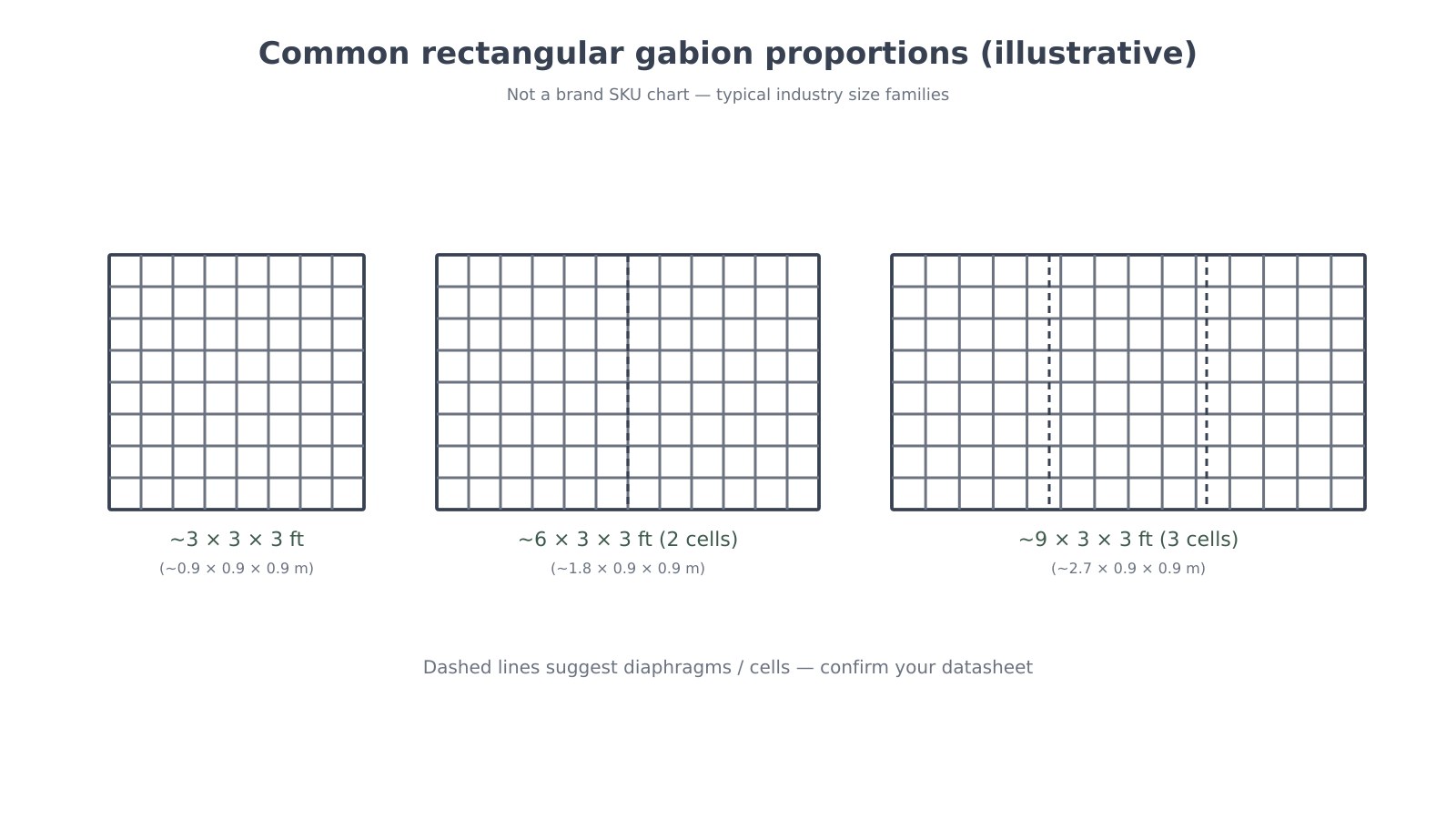
Longer baskets are usually divided into cells by diaphragms (internal mesh partitions) so cell length stays manageable — a common rule of thumb in industry descriptions is that cell length does not greatly exceed the basket width.
Manufactured dimensions are frequently allowed a tolerance around ±5% of the ordered size before filling (check your standard/datasheet).
Typical basket dimensions (common chart families)
North American foot-based sizes (often listed)
These footprints appear repeatedly in welded-gabion technical tables and supplier charts. Capacities below are approximate geometric volumes for illustration — packing efficiency and stone voids change real stone tonnage.
| Typical L × W × H | Approx. metric | Cells (typical) | Approx. volume |
|---|---|---|---|
| 6 ft × 3 ft × 3 ft | ~1.8 m × 0.9 m × 0.9 m | 2 | ~2.0 yd³ (~1.5 m³) |
| 9 ft × 3 ft × 3 ft | ~2.7 m × 0.9 m × 0.9 m | 3 | ~3.0 yd³ (~2.3 m³) |
| 12 ft × 3 ft × 3 ft | ~3.7 m × 0.9 m × 0.9 m | 4 | ~4.0 yd³ (~3.1 m³) |
| 6 ft × 3 ft × 1.5 ft | ~1.8 m × 0.9 m × 0.45 m | 2 | ~1.0 yd³ (~0.8 m³) |
| 9 ft × 3 ft × 1.5 ft | ~2.7 m × 0.9 m × 0.45 m | 3 | ~1.5 yd³ (~1.1 m³) |
| 12 ft × 3 ft × 1.5 ft | ~3.7 m × 0.9 m × 0.45 m | 4 | ~2.0 yd³ (~1.5 m³) |
| 6 ft × 3 ft × 1 ft | ~1.8 m × 0.9 m × 0.3 m | 2 | ~0.7 yd³ (~0.5 m³) |
| 9 ft × 3 ft × 1 ft | ~2.7 m × 0.9 m × 0.3 m | 3 | ~1.0 yd³ (~0.8 m³) |
| 12 ft × 3 ft × 1 ft | ~3.7 m × 0.9 m × 0.3 m | 4 | ~1.3 yd³ (~1.0 m³) |
Note on seller “size codes”: Some US catalogs label families like the 6×3×3 / 9×3×3 / 12×3×3 and half-height variants with letter codes (for example A–F). Those letters are that seller’s catalog labels, not a universal industry standard. GabionBaskets.com describes the dimensions; we do not operate a fake A–F storefront.
Metric modular sizes (often listed internationally)
Woven-gabion technical sheets commonly list modules such as:
| Typical L × W × H (m) | Approx. US customary |
|---|---|
| 2 × 1 × 0.3 | ~6.6 × 3.3 × 1.0 ft |
| 2 × 1 × 0.5 | ~6.6 × 3.3 × 1.6 ft |
| 2 × 1 × 1.0 | ~6.6 × 3.3 × 3.3 ft |
| 3 × 1 × 0.3 / 0.5 / 1.0 | ~9.8 × 3.3 × (1.0 / 1.6 / 3.3) ft |
| 4 × 1 × 0.5 / 1.0 | ~13.1 × 3.3 × (1.6 / 3.3) ft |
Landscape and architectural welded products may also be sold as custom panel sizes in increments of the mesh spacing (for example, multiples of a 3 in / 75 mm grid). Availability is brand-specific.
Typical mesh openings
| Mesh family | Typical opening you’ll see quoted | Source-type context |
|---|---|---|
| Welded baskets | Often 3 in × 3 in (75 mm × 75 mm) | Common in ASTM A974-oriented manufacturer charts; other spacings exist for custom/architectural mesh |
| Woven baskets | Often 8×10 mesh with nominal D ≈ 3.25 in (83 mm) | Common in ASTM A975 Table-style manufacturer data; opening tolerance often about ±10% of nominal in those texts |
| Mattresses | Often smaller / different aspect (e.g. about 1.5 in × 3 in / 38 mm × 75 mm welded in some charts) | Mattress products are shallower; see Gabion mattresses |
Uncertainty: DIY “garden cage” products online may use non-civil mesh sizes. Match opening to stone, not just aesthetics.
Typical wire diameters (basket mesh)
Values below are illustrative of common chart rows. Finished diameter changes if a polymer coating is applied over the metallic coat.
| Role | Typical metallic diameter (order of magnitude) | Notes |
|---|---|---|
| Welded basket mesh | About 0.106 in (2.7 mm) or 0.120 in (3.05 mm) | Contemplated in many A974-style tables (PVC vs metallic-coated rows differ) |
| Woven basket mesh (e.g. 8×10) | About 0.120 in (3.05 mm) galvanized mesh wire in many Style 1 charts | Selvedge (edge) wire is often heavier than mesh wire |
| Lacing wire | Often near 0.087 in (2.2 mm) class in charts | Used to sew panels/edges |
| Spiral binders (welded) | Often similar order to mesh wire (e.g. ~0.106–0.120 in) | Alternate or complement to lacing / rings |
Gauge numbers (11 ga, 12 ga, etc.) appear in marketing copy; convert carefully — measure or trust the mm/inch on the datasheet.
Fill stone size vs basket height (typical guidance)
Public NRCS-style construction guidance and similar industry practice often align stone with unit type roughly like this:
| Unit | Predominant rock size (typical) | Practical rule |
|---|---|---|
| Standard baskets (heights such as 12 / 18 / 36 in) | About 4–8 in (100–200 mm) | Large enough to stay behind the mesh; durable, clean stone |
| Mattresses (shallower) | About 3–6 in (75–150 mm) in many parallel tables | Still larger than mattress mesh openings |
At least a large majority of pieces (by weight) are expected to fall in the specified band in formal specs — DIY buyers should still reject undersized gravel that can rattle out of the face.
→ More on rock selection: Gabion fill stone
Coatings (spec literacy)
When a datasheet lists “Style” or coating class, it is usually distinguishing:
- Metallic zinc (or other metallic) coating alone
- Metallic + polymer (often PVC) for chemical/abrasion/UV-exposed service
Polymer adds to the finished outer diameter. Color options exist on some coated products but availability fluctuates. Deep dive: Mesh and coatings.
Mattresses vs baskets (size mindset)
- Baskets: deeper modules for walls and stacked structures.
- Mattresses: large plan area, small thickness — channel linings, slope protection, toe protection.
Do not assume basket stone sizes or mesh automatically transfer. See Gabion mattresses and Erosion & riverbanks.
DIY checklist before you order
- Confirm welded vs woven for look and site needs → comparison guide.
- Pick dimensions that fit your run (minimize awkward cuts; plan diaphragms/cells).
- Match mesh opening to available local stone.
- Choose coating for climate, soil chemistry, and water exposure.
- Count fasteners, stiffeners, and lids — kits differ.
- Plan foundation, drainage, and height limits → Install, Retaining walls, Mistakes.
- Estimate stone volume and freight early → Cost factors (no fake SKUs on this site).
Source types used for these “typical” ranges
- Manufacturer technical data sheets referencing ASTM A974 / ASTM A975 mesh and wire tables
- Public construction specifications for wire-mesh gabions and mattresses (e.g. NRCS-style guidance on basket heights and rock size bands)
- Widely repeated industry size charts for 6/9/12 ft lengths at 3 ft width
We intentionally do not paste copyrighted tables verbatim or invent brand SKUs or prices.
Related pages
- What are gabion baskets?
- Welded vs woven
- Mesh & coatings · Fill stone · Install
- Hub: GabionBaskets.com homepage
Educational disclaimer: Content on GabionBaskets.com is for general education only. It is not a site-specific design, engineering stamp, or construction contract. Tall walls, walls supporting structures or traffic, channel work, and other critical applications need a qualified designer or engineer. Always follow local building codes, permits, and the manufacturer’s assembly instructions for the baskets and coatings you buy.