Gabion Fill Stone: Size and Type
The mesh is only half the system. Fill stone supplies mass, interlock, drainage voids, and the finished look. GabionBaskets.com explains size bands, rock shape, and practical sourcing tips using typical public construction guidance (including NRCS-style Construction Specification 64 rock tables) and common manufacturer notes — not a quarry bid or engineered gradation for your site.
Match stone to your mesh opening first: Sizes & specs, Mesh & coatings.
The non-negotiable rule
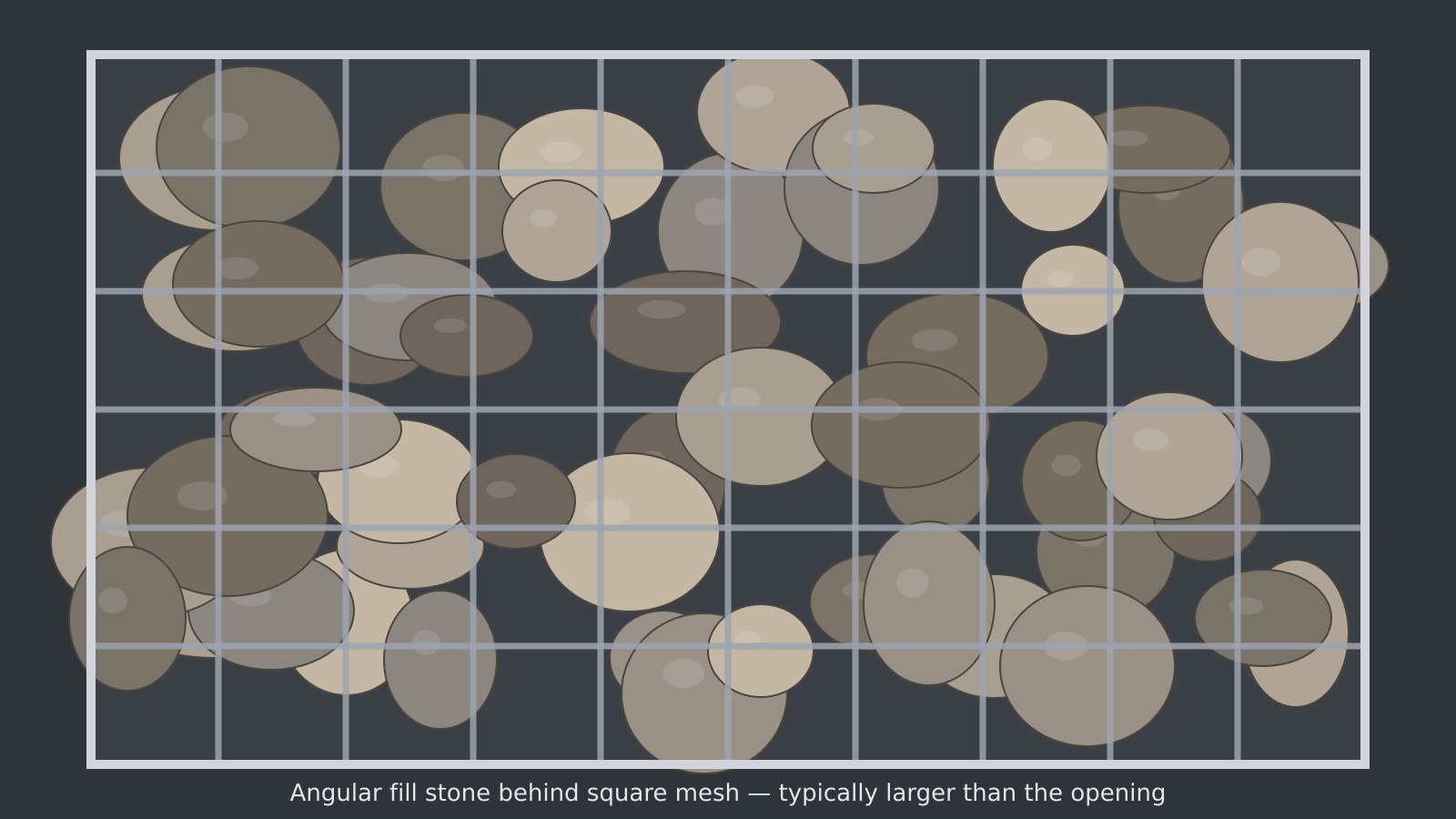
Rock must be larger than the mesh openings so pieces cannot work through the face. If you buy decorative “garden cage” mesh with finer openings, you need carefully matched fill (or an inner liner only if the manufacturer allows it for that use). Do not assume every bag of landscaping cobble fits every cage.
Typical size bands (industry chart language)
Public NRCS-style tables for wire-mesh gabions and mattresses commonly align predominant rock size with unit height roughly like this:
| Unit type (typical heights) | Predominant rock size (typical) | Often-cited min / max dimension notes |
|---|---|---|
| Standard baskets (e.g. 12, 18, or 36 in / about 0.3, 0.45, or 0.9 m high) | About 4–8 in (100–200 mm) | Many parallel tables cite a minimum near 4 in (100 mm) and a maximum near 8 in (200 mm) for that predominant band |
| Mattresses (shallower units, e.g. about 6–12 in / 150–300 mm class) | About 3–6 in (75–150 mm) in many parallel tables | Still larger than the mattress mesh openings |
Formal specs often require that a large majority of particles by weight (commonly cited as at least about 85%) fall in the predominant band, with limited oversize/undersize allowances that still must not sit on exposed faces. DIY buyers should still reject loads of gravel that rattle out of the mesh.
Some manufacturer notes allow a small percentage of oversize (with a hard cap — e.g. not larger than about 10 in / 250 mm in some published gabion rock notes) and undersize — confirm the datasheet for civil work. We do not invent a universal gradation curve here.
→ Mattresses: Gabion mattresses · Erosion context: Erosion & riverbanks
Angular vs rounded rock
| Shape | Pros | Cons / cautions |
|---|---|---|
| Angular / crushed quarry stone | Interlocks well; packs into a denser mass; preferred on many structural faces | Can abrade polymer coatings if dumped carelessly |
| Rounded river rock / cobbles | Attractive for decorative planters and seating | Can shift more easily; more voids; less “lock” on gravity walls |
For retaining and other structural faces, angular stone is usually the smarter structural choice. Rounded stone can still work for low decorative features if size vs mesh is correct and you accept a different look and packing behavior — Retaining walls, Landscape & garden.
Rock quality (what “durable” means here)
Industry and manufacturer language typically asks for rock that is:
- Hard and durable — does not crumble after wetting/drying or freeze-thaw in your climate
- Clean enough — excessive fines/clay clog voids and muddy the face
- Sound — avoid soft shale, mudstone, or highly weathered pieces for structural fills
ASTM-oriented riprap/rock quality references appear in civil specs; homeowners can start with a reputable local quarry asking for “gabion stone” or sized riprap in the 4–8 in (100–200 mm) band and inspecting a sample pile before delivery.
Decorative vs structural fill
| Goal | Practical tip |
|---|---|
| Visible modern wall face | Hand-place a consistent color/size on the exposed face; fill the core with sound angular rock that still meets size rules |
| Budget backyard terrace | Local angular quarry stone that meets size beats imported decorative rock that is too small |
| Planters | Confirm drainage; do not pack the cage entirely with soil — stone is the structural fill; planting details vary by design |
| Mixed “pretty face + cheap core” | Acceptable when both fractions stay behind the mesh and the face is carefully placed |
How much stone will you need?
- Compute basket volume (length × width × height) for each unit — tables and examples: Sizes & specs.
- Remember geometric volume ≠ solid rock volume — voids remain inside a packed gabion. Quarries usually sell by ton or cubic yard; ask them for a conversion for the stone you chose.
- Order a modest contingency for breakage, settlement, and face dressing (many practitioners order a bit extra rather than run short mid-wall).
- Price delivered stone separately from empty baskets — stone and freight often dominate: Cost factors.
We do not invent a single tons-per-yard³ factor that fits every geology.
Placement tips that protect the mesh
Drawn from common public construction and manufacturer practice (educational summary):
- Fill in lifts; do not let one cell lead its neighbor by more than about 12 in (300 mm) of depth
- Machine-place, then hand-work voids and faces
- Hand-arrange the outer layer on exposed faces for appearance and fewer face voids
- Avoid high free-fall drops that impact mesh or coatings
- Install bracing/stiffeners as lifts rise — How to install
Common fill mistakes
- Buying drain rock / gravel sized for pipe bedding (too small)
- Pretty river cobbles that tumble out of 3 in (75 mm) openings
- Dirty loads that turn the face into a mud cake after the first storm
- One giant boulder per cell that leaves cavernous voids and stress points
- Ignoring mattress vs basket size bands
Prevention checklist: Common mistakes.
Quick buyer script for the quarry
“I need durable gabion fill, mostly 4–8 inches (100–200 mm), angular if you have it, clean of fines, for mesh openings about [your opening]. Can I see a stockpile sample and get a delivered price per ton / per cubic yard?”
Bring a photo of your mesh or a sample panel opening if possible.
Related guides
- Sizes & specs · Install overview
- Retaining walls · Landscape & garden
- Cost factors · Common mistakes
- FAQ · Hub: GabionBaskets.com homepage
Questions about our guides? See Contact. About · Privacy.
Educational disclaimer: Content on GabionBaskets.com is for general education only. It is not a site-specific design, engineering stamp, or construction contract. Tall walls, walls supporting structures or traffic, channel work, and other critical applications need a qualified designer or engineer. Always follow local building codes, permits, and the manufacturer’s assembly instructions for the baskets and coatings you buy.